Thailand's cannabis market is not collapsing. It is consolidating.
The shop count fell by roughly 40 percent. Revenue fell by less. Divide one by the other and revenue per surviving shop went up.
Three findings, measured. The report has 101 pages of them.
Measured in the field. Verified against the record.
We completed the full legal retail licensing process end to end: the queues, the sequencing, the requirements nobody tells you about until you are already in motion. We ran the shop.
Over three years we visited more than 850 dispensaries across Thailand, 650 in Bangkok alone, and bought from the counters as paying customers with our own money. We sat with more than 30 farm owners and worked through what cultivation actually clears.
That is why this report can price farm-gate, map the three routes flower takes to a licensed counter, and cost a compliant dispensary line by line.
Fieldwork tells you what is happening. It does not prove it. So every finding was checked against the public record and, where the record was silent, against the agency itself.
The national licence registry, pulled and diffed across the year, shop by shop. The Royal Gazette and ministerial regulations, read in the original, not summarised from a press release. Company filings at the business registrar for named operators. Import statistics from destination countries, because an export claim that does not appear at the receiving end did not happen. Where no public figure existed, we wrote to the agency and recorded the answer, including when the answer was that no such figure exists. Those confirmed absences are in the report too, because a market with no official aggregate is a fact an investor needs.
Where two independent methods exist, both are run, and the report states how far apart they land.
Ask the analyst who did the fieldwork. $199.
One call, 45 minutes, on your specific question: a location, a partner, a licence, a number that does not add up. You get an answer from someone who has stood behind the counter, not a summary of the report.
If you buy the report within 30 days, the $199 comes off the price. You pick the slot and pay on the booking page; afternoons, Bangkok time.
Legal holds the money. Illegal holds the masses.
By value, the legal channel holds the majority of what Thailand spends on cannabis: premium, traceable, taxed. By volume and headcount, the illegal market holds the majority: more consumers, far more grams, at a fraction of the price. Miss that inversion and you mis-size the market in either direction. It is the single most important thing desk analysis cannot see, and it is why a large share of the flower on licensed shelves, by weight, is grey.
The scissors is the fourth finding. The shares are in the report.
You could size this market off a forecast that already broke.
The desk models put Thailand at $7 to $9 billion by 2030, a pre-crash growth rate run through the drawdown that has already happened. The report shows the figure the ground actually supports, and which blade of the scissors your capital should follow.
See the report →You may be building for a market whose shape you have backwards.
Assume it is mostly legal by volume and you will price, position and stock for the wrong consumer. Getting it right is the difference between entering the growing pool and the shrinking one.
See the report →You can feel the consolidation. This is how you measure it before your competitors do.
Which shops are taking the revenue as the count falls, where the grey flower actually flows, what farm-gate really clears. And the sorting is not finished. 4,587 licences expire in 2026 and 5,210 in 2027.
Ask the analyst · $199 →There are two kinds of Thailand cannabis report. You have only ever been sold one.
One kind is written from a desk, modeling the market from a legalisation headline and a few press releases. It is why they all cite each other, and why none of them saw the consolidation, the grey-market flow, or the wall that caps exports. The other kind is measured on the ground, at the counter, with our own money.
23 chapters. Here is every one of them.
- 1. Executive Summary
- 2. Research Methodology
- 3. Market Definition and Segmentation
- 4. National Retail Market Sizing
- 5. Total Market Map: Legal and Illegal by Layer
- 6. Consumer Analysis
- 7. Macro and Tourism Context
- 8. Regional and Category Segmentation
- 9. Cultivation and Farm-Gate
- 10. Production and Disposition
- 11. Wholesale and Distribution
- 12. Export and the EU-GMP Throttle
- 13. Extract and Hash Opportunity
- 14. Value-Add Market Map and Forecast to 2030
- 15. Regulatory Framework
- 16. Foreign Investment Structures and the Ownership QuestionFree
- 17. Operators and Company Financials
- 18. Competitive Structure
- 19. Drivers, Restraints, Opportunities, Challenges
- 20. SWOT
- 21. Branding and Positioning
- 22. Risk Matrix
- 23. Recommendations by Stakeholder
- A. The Ownership Question: Three Ways to Structure the Same Deal
- B. Source Register
- C. Glossary
Three pages, as they appear.
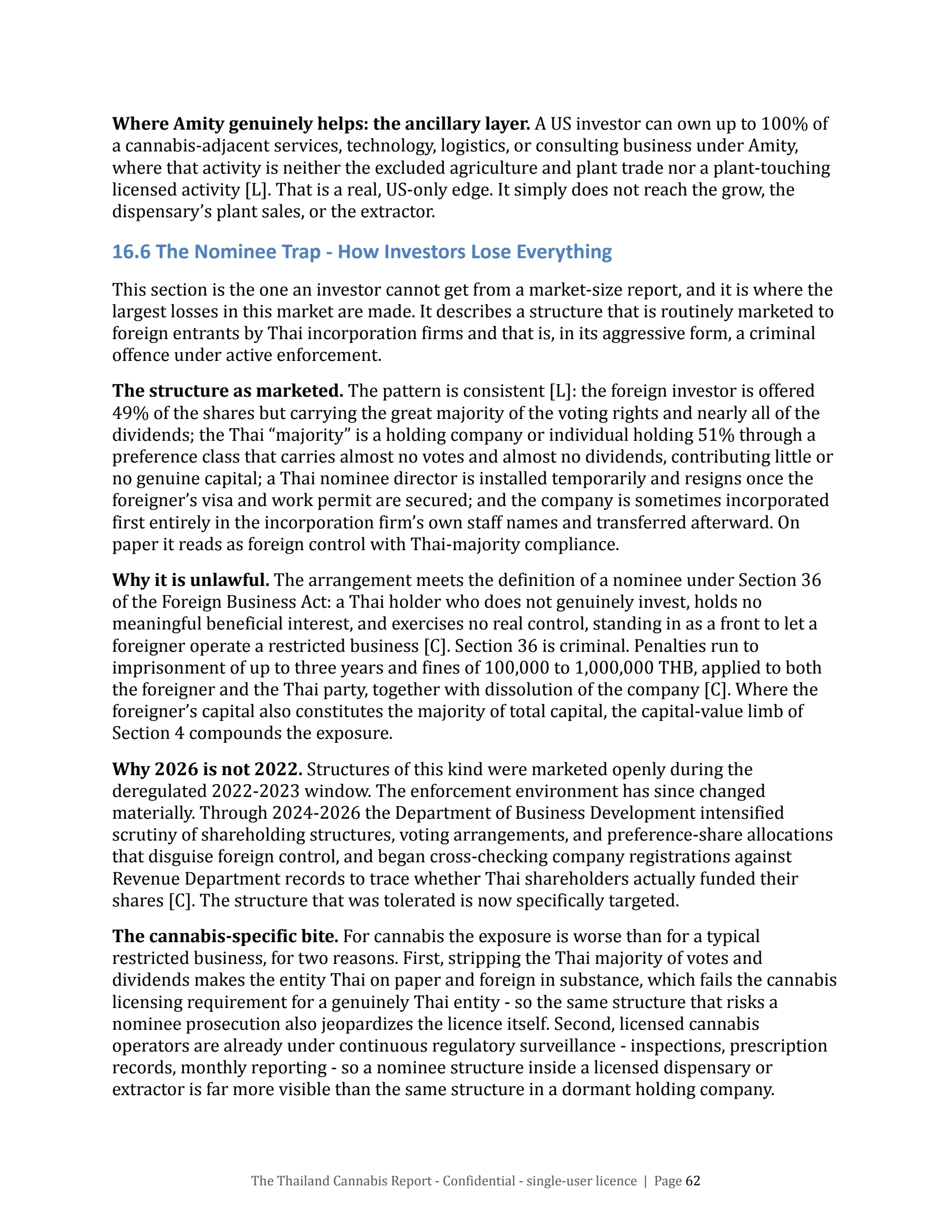
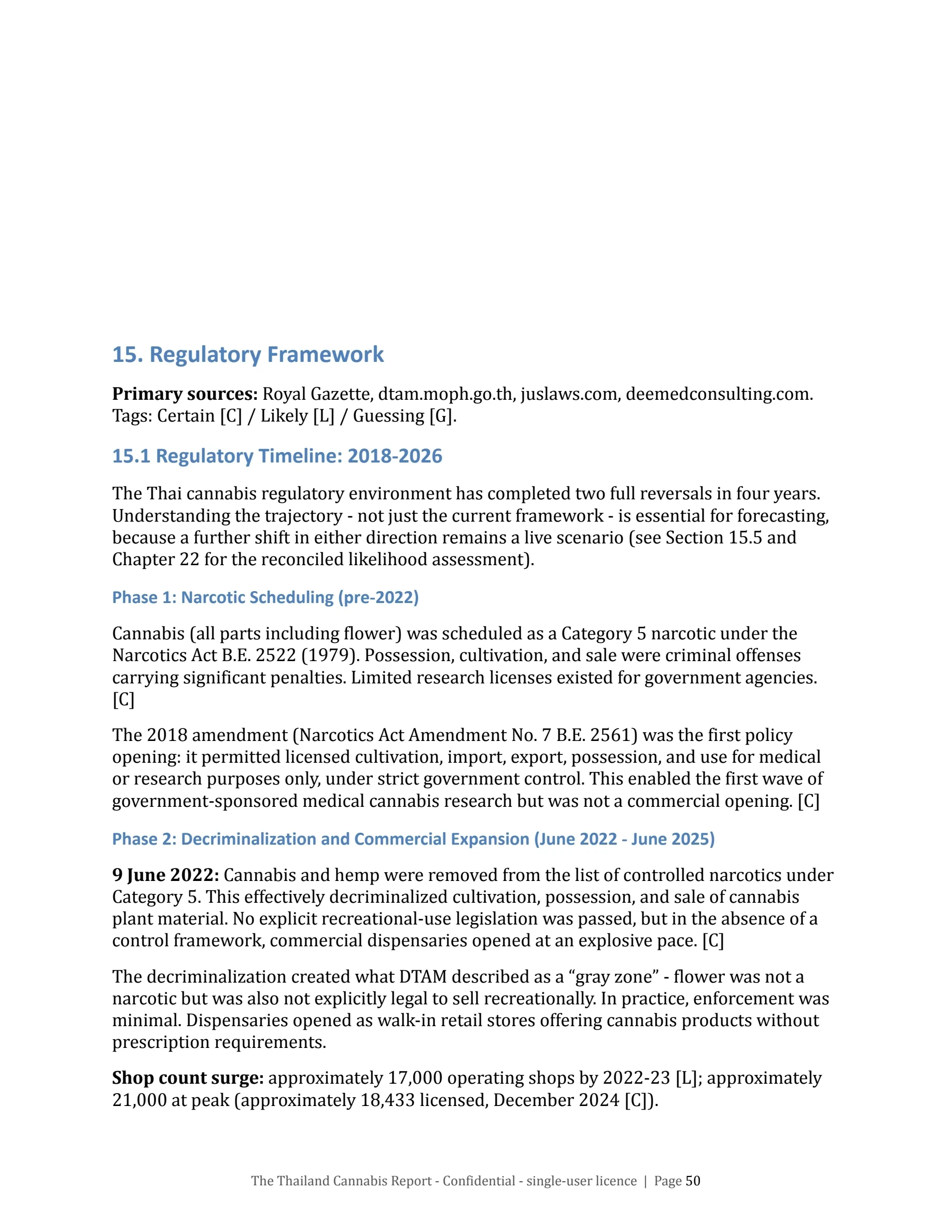
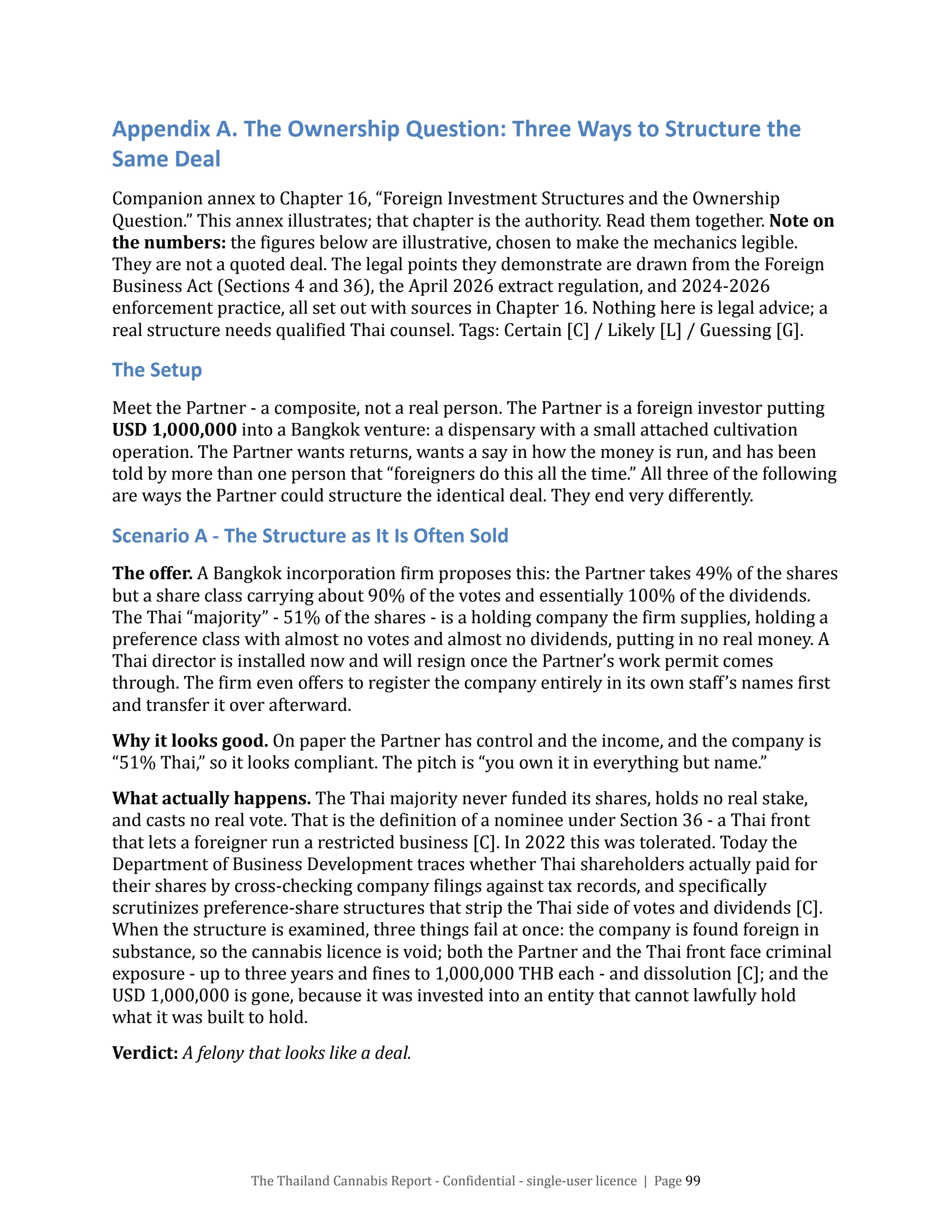
From the methodology, regulatory and ownership chapters. Figures are withheld. The writing is not.
Start with a call. The rest follows.
Every purchase starts with the $199 analyst call. If you go on to buy, the $199 comes off the price. If we tell you the report is not for you, it is the only thing you have spent.
- 45 minutes on your question
- Credited against any report purchase within 30 days
- The complete 2026 report, 23 chapters plus appendices, every figure confidence-tagged
- A 15-minute follow-up call
- Post-purchase access for your questions
- Available after the analyst call; balance invoiced
- Everything in the report
- Twelve months of the industry intelligence briefing
- A 45-minute call on your situation
- Available after the analyst call; balance invoiced
- Bespoke data pulls and entry diligence
- Direct access to the operator network
- Scoped to your question, for funds and operators moving capital
You are not left to decide alone, and you are not left waiting after you do.
If you go on to the report, we invoice the balance and deliver it as a PDF, with direct analyst access for your questions once you have read it. If you do not, the $199 is the only thing you spent.
See the standard for yourself. A full chapter, free.
Not a teaser and not a table of contents - a complete, worked chapter with the charts, the sourcing, and the confidence tags, so you can judge the rigor before you spend a baht. The load-bearing numbers and the 2030 forecast live in the full report.
- A real chapter, in full
- The method behind the numbers nobody publishes